What is Carbon Black and Why Particle Size is Important?
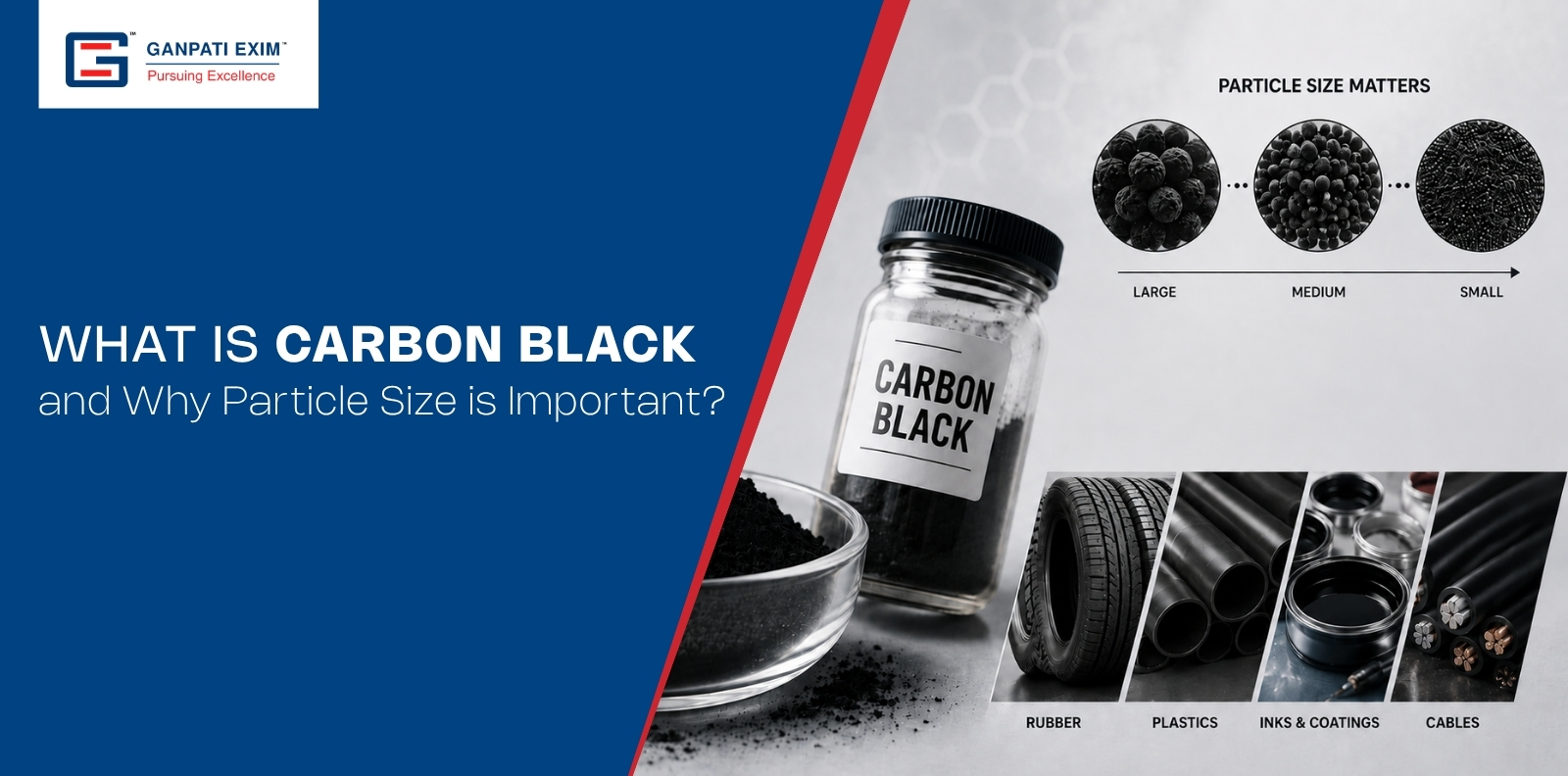
Carbon black is a fine carbon material used mainly as a reinforcing filler, pigment and functional additive. Carbon black particle size is important because it affects surface area, reinforcement, blackness, dispersion and processing. The right particle size depends on the application and required product performance.
What is Carbon Black?
Carbon black is a finely divided form of elemental carbon produced through the controlled thermal decomposition or incomplete combustion of hydrocarbon-based feedstocks.
It is widely used across industries including rubber, tyres, plastics, paints, coatings and printing inks.
In rubber applications, carbon black is primarily used for reinforcement, helping improve properties such as strength, abrasion resistance and durability. It is also valued for its deep black colour and UV protection in several applications.
Why is Carbon Black Particle Size Important?
Particle size is an important property when selecting a carbon black grade because it influences how the material performs within a formulation.
1. Reinforcement
Smaller carbon black particles generally have a higher surface area, allowing greater interaction with the rubber polymer. This can contribute to improved tensile strength, abrasion resistance and durability.
2. Blackness and Tinting Strength
Particle size also affects colour performance. Finer particles generally provide deeper blackness and higher tinting strength, making them useful where appearance and colour intensity are important.
3. Dispersion and Processing
Particle size and surface area influence how carbon black disperses during mixing. The selected grade should provide the right balance between dispersion, processing and final performance.
4. Overall Product Performance
The appropriate carbon black particle size can help manufacturers achieve the desired balance of strength, durability, appearance and processing characteristics.
However, smaller particle size is not automatically better. Carbon black should be selected based on the complete application requirement.
Carbon Black Particle Size vs. Structure
Particle size refers to the size of the primary carbon black particles, while structure describes how these particles are fused together to form aggregates.
Both properties influence important characteristics such as reinforcement, viscosity, dispersion and processing behaviour. Therefore, manufacturers should consider particle size together with surface area and structure when selecting a carbon black grade.
How to Choose the Right Carbon Black Grade?
Different carbon black grades offer different performance characteristics. Common grades used in rubber applications include N220, N234, N326, N330, N339, N550, N660 and N772.
The appropriate grade depends on:
- Required reinforcement
- Abrasion resistance
- Blackness and tinting strength
- Dispersion requirements
- Processing conditions
- Final product specifications
For manufacturers and procurement teams, understanding these properties can help in selecting a carbon black grade that meets both performance and processing requirements.
Conclusion
Carbon black particle size plays an important role in reinforcement, colour, dispersion and overall product performance. However, particle size should not be considered in isolation. Surface area, structure, processing requirements and the final application are equally important.
Choosing the right carbon black grade can help manufacturers achieve consistent quality, reliable processing and the desired performance in their finished products.
Looking for the right carbon black grade for your application? Contact Ganpati Exim to discuss your requirements.
Frequently Asked Questions
What is carbon black used for?
Carbon black is used mainly as a reinforcing filler and pigment in rubber, tyres, plastics, coatings and printing inks.
Why does carbon black particle size matter?
Carbon black particle size affects surface area, reinforcement, blackness, dispersion and processing. Smaller particles generally provide higher surface area and can offer stronger reinforcement and tinting strength.
Is smaller carbon black particle size always better?
No. The ideal particle size depends on the required properties, processing conditions and end application. The right balance of particle size, surface area and structure is important.
Which carbon black grades are commonly used in rubber?
Common rubber grades include N220, N234, N326, N330, N339, N550, N660 and N772. Each grade offers different reinforcement and processing characteristics.